
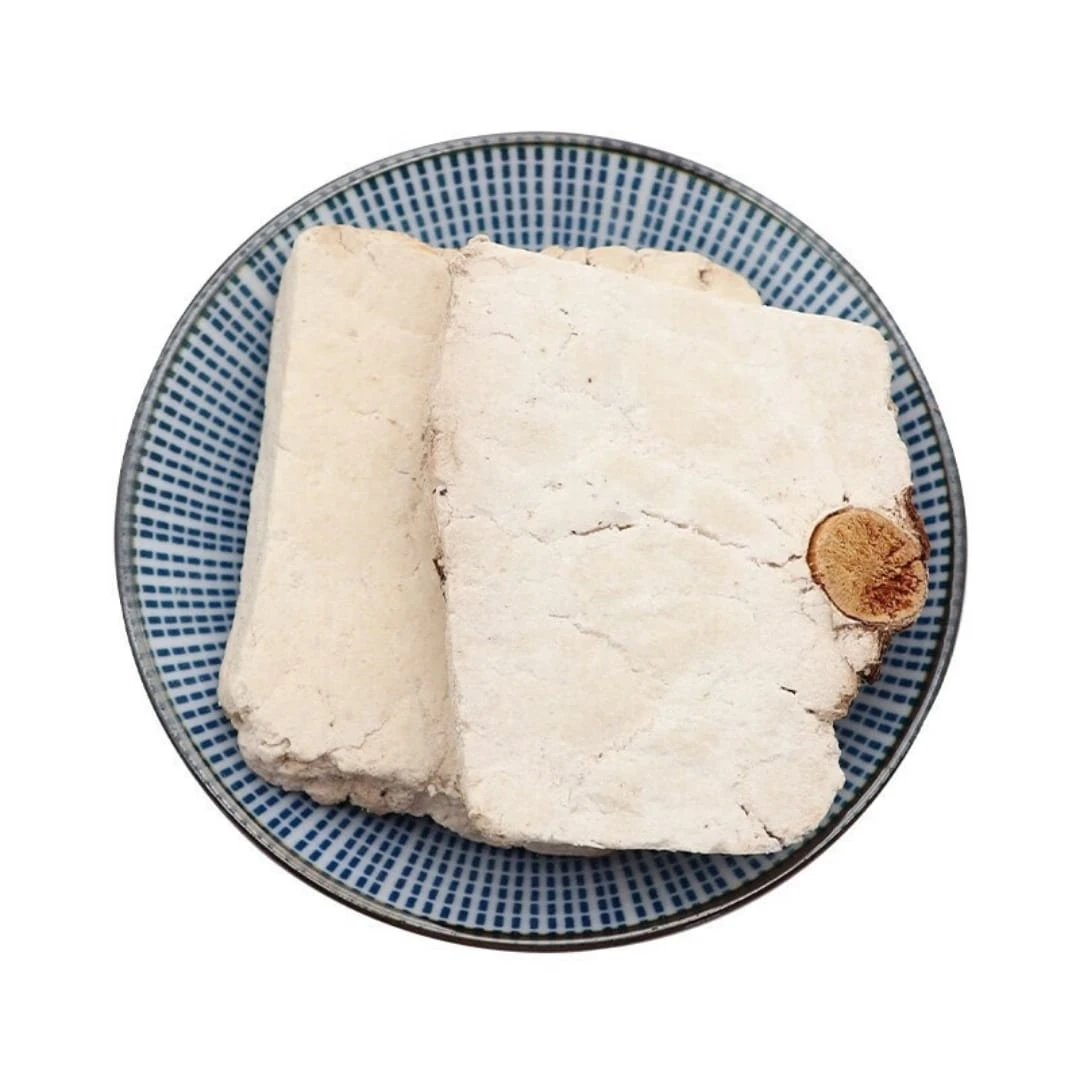


Product Introduction
Indian Bread with Pine, or Fuling with Pine, is a variation of the well-known traditional Chinese medicine, Fuling (Poria cocos). This particular type of Fuling grows in association with pine trees, specifically around their roots, which imparts a unique pine aroma to the sclerotium. This characteristic pine scent distinguishes it and is considered desirable in certain applications due to the belief that it enhances certain therapeutic properties. In traditional Chinese medicine (TCM), it shares many of the same fundamental properties as regular Fuling but may be preferred in formulations where the aromatic quality is believed to offer additional benefits.
Main Active Ingredients
The main active ingredients in Indian Bread with Pine are similar to those found in standard Poria cocos, including polysaccharides and triterpenoids. Polysaccharides, such as pachymaran, are known for their immunomodulatory and anti-tumor properties [1]. Triterpenoids, like pachymic acid, contribute to its anti-inflammatory and diuretic effects [2]. These compounds work synergistically to provide the therapeutic benefits associated with Fuling. The unique aspect of Indian Bread with Pine is the presence of volatile oils absorbed from the pine tree, which may contribute to its distinctive aroma, as well as potentially influencing its therapeutic actions.
Product Application Scenarios, Usage, and Dosage
Indian Bread with Pine is utilized in a range of applications within traditional Chinese medicine, mirroring the uses of Poria cocos. It is frequently prescribed to address dampness accumulation, which can manifest as edema, fatigue, or digestive issues [3]. It is also used to fortify the spleen, improving digestive function and nutrient absorption. Furthermore, it is employed to calm the spirit and alleviate insomnia, anxiety, and palpitations [4].
The typical dosage of Indian Bread with Pine usually ranges from 9 to 15 grams per day, administered in decoctions. It can also be found in powdered extracts, pills, and other prepared formulas [5]. The specific dosage and method of administration should be tailored to the individual's condition and under the guidance of a qualified TCM practitioner.
Introduction to the Source Plant, Distribution, and Growth Environment
Poria cocos is a fungus that parasitizes the roots of pine trees, commonly found in various parts of China, as well as other regions in Asia and North America [6]. It thrives in warm, humid environments, particularly in areas with sandy soil conducive to pine tree growth. The fungus forms a sclerotium, a hardened mass of mycelium, which is the part used medicinally.
Indian Bread with Pine specifically refers to the Poria cocos sclerotium that develops directly around the roots of pine trees. This close proximity allows the sclerotium to absorb volatile compounds from the pine, giving it its characteristic scent.
Harvesting, Processing, and Storage
The harvesting of Indian Bread with Pine typically occurs in the summer and autumn months. Harvesters locate the Fuling sclerotia near pine roots and carefully excavate them [7]. After harvesting, the sclerotia are cleaned, dried, and processed. The processing may involve slicing the sclerotium into smaller pieces or grinding it into a powder for use in various formulations.
Proper storage is crucial to maintain the quality and efficacy of Indian Bread with Pine. It should be stored in a cool, dry, well-ventilated place, away from direct sunlight and moisture. Storing it in airtight containers can help prevent mold growth and protect it from insect infestation [8]. Regular inspection for signs of spoilage is recommended to ensure that the herb remains potent and safe for consumption.
Citations:
- Wang, J., et al. "Structural characterization and immunomodulatory activity of a novel polysaccharide from Poria cocos." International Journal of Biological Macromolecules 126 (2019): 1237-1245.
- Li, T., et al. "Triterpenoids from Poria cocos and their anti-inflammatory activities." Journal of Natural Products 76, no. 3 (2013): 481-487.
- Bensky, D., et al. Chinese Herbal Medicine: Materia Medica. 3rd ed. Seattle, WA: Eastland Press, 2004.
- Chen, J. K., and T. T. Chen. Chinese Medical Herbology and Pharmacology. City of Industry, CA: Art of Medicine Press, 2004.
- 中华人民共和国药典委员会. 《中华人民共和国药典》. 北京: 中国医药科技出版社, 2020. (Pharmacopoeia of the People's Republic of China. Beijing: China Medical Science and Technology Press, 2020.)
- Dai, Y. C. "Polypore diversity in China with an annotated checklist of Chinese polypores." Fungal Diversity 57, no. 1 (2012): 149-320.
- Xu, X., et al. "Traditional uses, botany, phytochemistry, pharmacology and toxicology of Poria cocos: A review." Journal of Ethnopharmacology 215 (2018): 297-324.
- World Health Organization. Quality control methods for herbal materials. Geneva: World Health Organization, 1998.
Mia Wu

Hi, I’m Mia Wu! I love helping customers discover the best natural ingredients for their products. With a passion for herbs, spices, and fungi, I work to make sure you get only the finest raw materials. Let's grow together! 🌱✨







